Open Research (PY0663)… .

Prof. Thomas Pollet, Northumbria University (thomas.pollet@northumbria.ac.uk)

October 16, 2026

Outline

  • Why open research?

  • Preregistration and sharing your work

  • Escape room!

Who am I?

  • trained in Sociology (Ghent) → Evolutionary Psychology (Liverpool, NCL).
  • worked in Social Psychology depts. in Netherlands (Groningen, VU Amsterdam, Leiden)
  • At Northumbria University (dept. of Psychology) since 2017. I teach statistics at MRes. level - Open Research advocate.
Recent history

  • Why care about reproducibility?
  • I was there when it happened – sort of … .
  • Similar to Erdős number (how many links away from the mathematician):

→ Stapel = 2; Förster = 2; Smeesters = 2; Wansink = 2; Gino = 2;…
Diederik Stapel

  • Stapel was in Groningen and then moved to Tilburg.
  • In 2011, case came to light via student whistleblowers.
  • Stapel fabricated data for his PhD students’ (and colleagues’) studies, which they then analysed
  • 58 retractions; dismissed by Tilburg; voluntarily returned his PhD.

Some further background reading
Broader phenomenon

Publication pressure… .
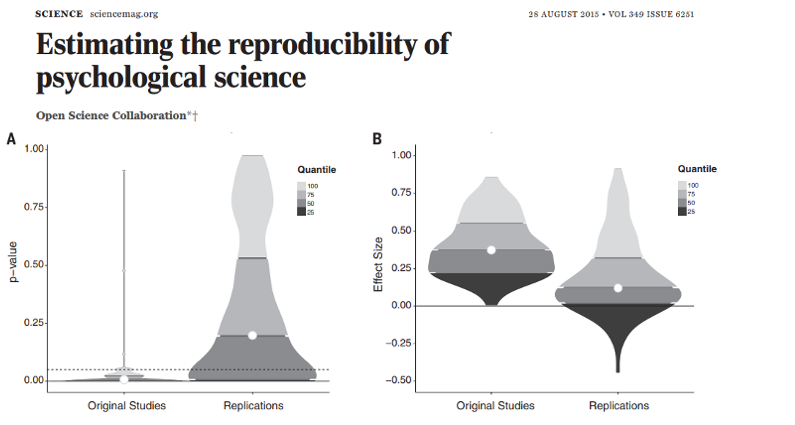
Key findings: Replication project

Key Findings (Open Science Collaboration, 2015):

  • 97% of original studies had statistically significant results
  • Only 36% of replications had statistically significant results
  • Replication effect sizes were half the magnitude of original effects
  • 47% of original effect sizes were in the 95% CI of replication effect size
  • 39% of effects were subjectively rated to have replicated

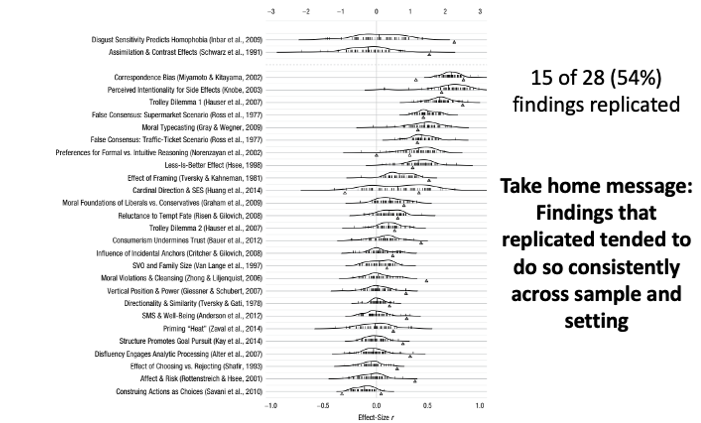
Many labs 2

Northumbria staff helped (e.g., Matthew Haigh, Nick Neave, Michael Smith) (Klein et al., 2018)
So, what is open research.

From M. R. Munafò et al. (2017):

“The process of making the content and process of producing evidence and claims transparent and accessible to others” to enable the reproducibility and replicability of a research claim to be evaluated

Reproducibility: Given the same evidence (i.e., data) and the same analysis, can the same result be obtained?

Replicability: If a study is repeated with the same procedures, therefore generating new data, will the same finding be obtained?

Open research

As psychological scientists, it is important that we uphold some key principles of scientific endeavour: openness, transparency, rigour, reproducibility, replicability and accumulation of knowledge – these principles capture the ideals of ‘Open Science’ (/Open Research)

Threats to reproducibility and replicability
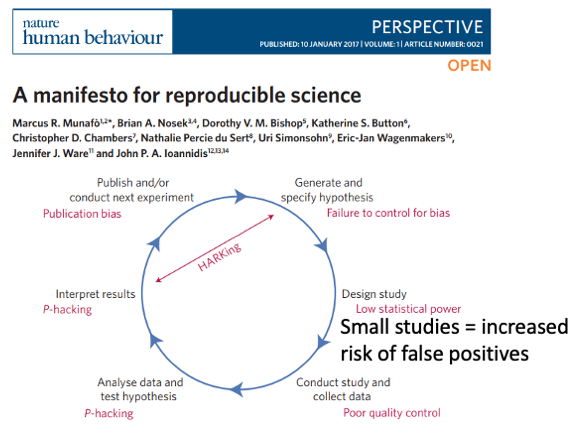
Figure: M. R. Munafò et al. (2017), CC BY 4.0.

YOU!

  • Pre-registration:
    • Specify your research plan and analyses upfront
    • Specify whether research is exploratory or confirmatory
  • Open data: Make data and analysis code openly available on a repository in accordance with FAIR principles (Findable, Accessible, Interoperable, Reusable)
OSF is changing

  • From 16 November 2026: no new OSF projects can be created.
  • From 19 February 2027: all existing OSF projects become read-only.
  • What continues: preregistration (OSF Registries) and preprints.

→ So: don’t start a new OSF project for your thesis. You can still preregister on OSF, but your data will need a different home.

First: talk to your supervisor

  • Where will your working files live during the project? (University OneDrive, as in your ethics application.)
  • What will you share at the end? (e.g., anonymised data, a codebook, your analysis code.)
  • Do your participant information sheet and consent form allow this? Only share what participants agreed to.
  • Which repository will you use, and who will deposit it? (See the next slides.)

Where does what go?

What Where
Your preregistration OSF Registries
Working files during the project University OneDrive
Final anonymised data, materials, and code A repository: Zenodo or Figshare

Preregistering on OSF

  1. Go to OSF Registries and log in.
  2. Click ‘Add a Registration’. You can start from scratch: no project is needed.
  3. Choose a template. ‘OSF Preregistration’ is the most commonly used; discuss with your supervisor which fits your study.
  4. Fill in the template, add your supervisor as a contributor, and attach any files (e.g., materials) as part of the submission.
  5. Submit: make it public straight away, or embargo it for up to 4 years.

Sharing your data: two routes

Route 1: Northumbria’s repository, via your supervisor

  • Northumbria Research Data is the university’s repository, intended for research data deposited by staff.
  • Discuss with your supervisor whether they will deposit your anonymised data there.

Route 2: your own account

  • Register a personal account on Zenodo or Figshare.
  • Use a non-university email address: your student email will stop working after you graduate, and you would lose access to your own deposit!
  • Add your supervisor as a co-author.

Depositing on Zenodo or Figshare

  1. Prepare your files: anonymised data, a README/codebook, and your analysis code.
  2. Create a new record. Zenodo: ‘+’ → ‘New upload’. Figshare: ‘My content’ → ‘Items’ → ‘Create new’.
  3. Upload your files and add a title, authors (including your supervisor), a description, and a licence.
  4. Check everything, then publish: the record is permanent, and you get a DOI to cite in your thesis.

Practise first in the Zenodo sandbox: nothing there is permanently published.

Some myth busting…

Myth: If I preregister, I’ll get ‘scooped’.

Actually the opposite is true:

  • Preregistration is date stamped
  • You can stake your claim to your ideas earlier
  • Preprints establish first publication of a result/idea

→ If you are really, really, really worried, you can embargo your pre-registration.

Myth: Open science prevents exploratory research

Open research principles merely require you to:

  • Establish upfront whether research is exploratory or confirmatory
  • Prevents falsely claiming work is confirmatory
  • Prevents HARKing (Hypothesising After Results are Known)

Myth: Preregistration prevents me from changing plans

  • Changes can be documented: Update button on OSF. Document the rationale for any deviations from your original plan. Or make a separate document and upload this.
  • But it is important to be transparent about changes.
  • Your preregistration is a plan, not a prison!

Myth: I have to share ALL my data

Sometimes not possible to share everything, for example:

  • Commercial sensitivity
  • Preservation of anonymity
  • Ethical constraints

→ “As open as possible, as closed as necessary”

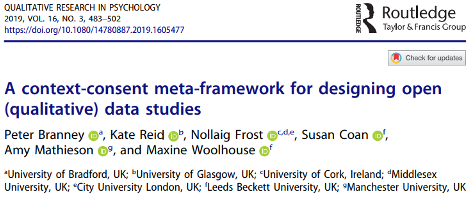
Myth: Open research not relevant for qualitative data

  • There is a qualitative research template.
  • Speak to your supervisor. “As open as possible, as closed as necessary.”
Open science escape room?

Can you escape?

This works best on a larger screen (so not a phone). Loading time is determined by your browser,… .

https://tvpollet.github.io/shiny_live_open_science_escape_room

Any Questions?

http://tvpollet.github.io

Bluesky: https://bsky.app/profile/tvpollet.bsky.social
Acknowledgements

I am greatly indebted to my colleagues who helped me along the way. This talk is (in part) based on slides from Dr. Michael Smith.

Slides were built with Quarto and reveal.js. Many thanks to those building packages and supporting the R eco-system.

You for listening!

References and further reading

Chambers, C. (2017). The Seven Deadly Sins of Psychology A Manifesto for Reforming the Culture of Scientific Practice. Princeton University Press.
Goldacre, B. (2014). Bad pharma: How drug companies mislead doctors and harm patients. Macmillan.
Goldacre, B., & Farley, R. (2009). Bad science. Fourth Estate London.
Klein, R. A., Vianello, M., Hasselman, F., Adams, B. G., Adams, R. B., Alper, S., Aveyard, M., Axt, J. R., Babalola, M. T., Bahník, Š., Batra, R., Berkics, M., Bernstein, M. J., Berry, D. R., Bialobrzeska, O., Binan, E. D., Bocian, K., Brandt, M. J., Busching, R., … Nosek, B. A. (2018). Many Labs 2: Investigating variation in replicability across samples and settings. Advances in Methods and Practices in Psychological Science, 1(4), 443–490. https://doi.org/10.1177/2515245918810225
Munafò, M. R., Nosek, B. A., Bishop, D. V. M., Button, K. S., Chambers, C. D., Percie du Sert, N., Simonsohn, U., Wagenmakers, E.-J., Ware, J. J., & Ioannidis, J. P. A. (2017). A manifesto for reproducible science. Nature Human Behaviour, 1(1), 0021. https://doi.org/10.1038/s41562-016-0021
Munafò, M., Noble, S., Browne, W. J., Brunner, D., Button, K., Ferreira, J., Holmans, P., Langbehn, D., Lewis, G., Lindquist, M., Tilling, K., Wagenmakers, E.-J., & Blumenstein, R. (2014). Scientific rigor and the art of motorcycle maintenance. Nature Biotechnology, 32(9), 871–873. https://doi.org/10.1038/nbt.3004
Open Science Collaboration. (2015). Estimating the reproducibility of psychological science. Science, 349(6251), aac4716. https://doi.org/10.1126/science.aac4716
Ritchie, S. (2020). Science fictions: Exposing fraud, bias, negligence and hype in science. Random House.